fredag 12 juni 2015

First days at sea

The first night on the ship was spent while still being moored in port. Me and my cabin mate's cabin was freezing because we couldn't find our thermostat. Stupid. Terrible night.
The following morning we set out from Honolulu on our half day transit to station ALOHA. Of course this time was filled with the regular safety instructions, drills, exploring the ship and signing our lives away (legal paperwork, thanks USA, sigh). We also had a science meeting just to go through the coming week.

The rest of the day was just full of preparations for the coming day and lots of good food in between. I was on the team responsible for setting up and deploying the sediment traps. These traps are nothing more than long plastic tubes which are designed to catch sinking particles in the water column at various depths. To keep the caught particles in the traps we filled them up with high salinity water and a preservative chemical.
It was a very mixed work-load which involved chemical preparation, pipetting, filtration and finally deploying the sediment traps by help of a crane, 1 km of rope, a dozen floats and a buoy. Since the last part of the work was conducted at back deck, it involved a lot more practical, hands on work where life vest and hard hat was required.

The second day started relatively late, at 09.00 where we sampled the third CTD (the water collector which is lowered down to a pre-set depth to collect water on its way up while also continuously measuring parameters like e.g. oxygen and fluorescence) of the day.
Since we will always be assisted by senior scientists on the course during our sampling and methodology, there is already a set routine and everything ran very smooth. We filtered water and stored away samples in the -20 freezer for e.g. ATP (adenosine tri-phosphate, which is the "energy currency" of all living cells), phosphorus, nitrate, and POC (particulate organic carbon).
So it was quick work and we were done by dinner, which was good for next up was the CTD or deck work which started at 2.30 the following night.

So the third day was an early one and I treated myself to a very early breakfast which honestly did wonders to everything but my mood this morning. I just couldn't fall asleep as early as I should have. We prepared the CTD, including loading the niskin bottles (so they can later be fired in the water column to enclose water from a certain depth), setting up the software for monitoring and recording the operation and putting out ropes for safely guiding the CTD in and out of the water when it is being deployed using a crane. Finally we also instructed the crane operator via radio as where to stop the CTD to fire niskin bottles and then helped recover the CTD when back at the surface.


All in all, very practical work which usually took an hour to one and a half. That meant that we had some time between CTD deployments (every third hour) and also when it was in the water (unless you were monitoring the operation and firing niskin bottles).
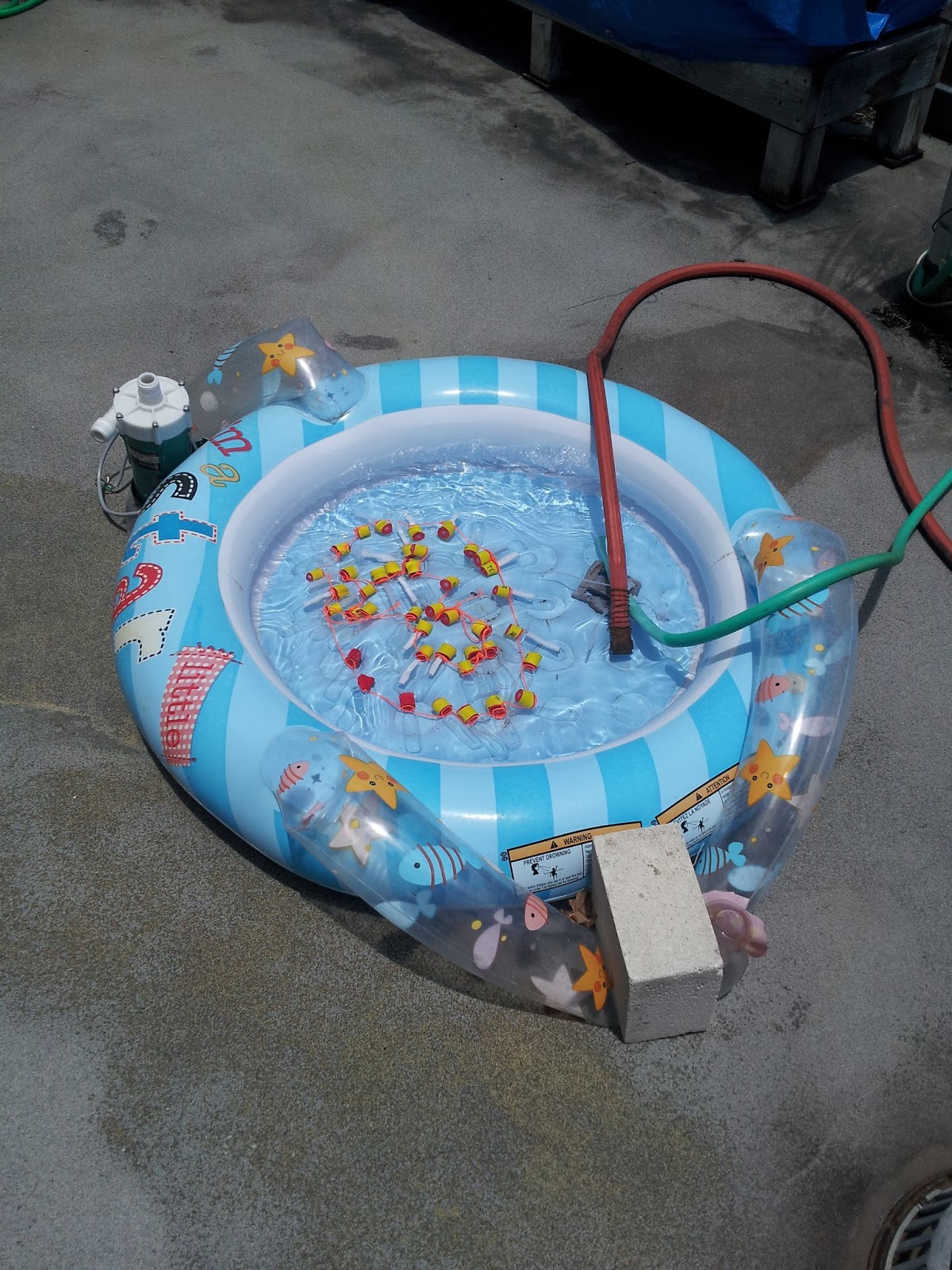
This down-time became a bit tedious at the end of the day but at least we stayed productive by decorating styrofoam cups. These cups will be submerged together with the CTD on the last day (purely for fun) when there will be a 4000 meter cast.
With that said you can all try and figure out what will happen with the cups during that operation. I will post the result at the end of the cruise.

onsdag 10 juni 2015

Research cruise postponed

By this time I should have been way out to sea, soon nearing station ALOHA (abbreviation for A Long-term Oligotrophic Habitat Assessment), which basically is a position some 10 hours by ship north of Oahu and Honolulu. To clarify; it's just a pre-decided patch of ocean marked with a single buoy.
Anyway, that didn't happen. The reason being some kind of engine failure of the research vessel, the R/V Kilo Moana. Thankfully it was quickly repaired and so we are finally scheduled to depart Honolulu tomorrow morning (local time), 2 days late.

During the wait for the ship to be repaired we had the days filled with Illumina sequencing and genomics theory as well as mathematical exercises where we calculated estimates of microbes and genetic material in the surface waters of station ALOHA. Not easy, but very interesting. There's a lot of stuff out there, both bound in cells and dissolved in the sea water.
Before going to the ship, we had a tour in the labs that we will use after the cruise. I've never seen such spacious and well organized labs, and on top of that they were filled with fancy instruments. Half of them I couldn't even tell what they were for. They even had an automatic pipetting instrument which did all pipetting work on 96-well plates by itself. Lastly, we were introduced to Illumina's prototype Next Seq.


Tonight is my first night on board, and it also marks the first day of my second research cruise. It will be a relatively short cruise (7 days is the current preliminary number due to the delay) where we will head out to station ALOHA (which actually is the same sampling location as for the Hawaii Ocean Time-series (HOT) which is an oceanographic monitoring program running since 1988), and sample as much as we can possibly manage. We have been divided into 5 groups (3-4 students in each group) which will rotate on a schedule of 5 different methodologies or sampling subjects. So my order of sampling is already decided and will be as follows: biomass, CTD, diversity, flow cytometry and finally productivity.
There will be loads of new methods to learn and get hands on experience of, which is great! I'm really looking forward to broadening my skills as a researcher. We will do many of the analysis preparations on board so once we get back to the lab we will start running the genome sequencing and metagenomics analysis which I'm looking forward to the most. It's a tough schedule but if the faculty are convinced we will manage then I am too I guess.


So far I've just had a short time to explore the ship, but what I've seen makes it fairly different from the last cruise ship I was on, the R/V L'Atalante.

For starters, this ship is smaller. It is 56 m long (30 m shorter) and 26 m wide (actually 11 m wider), and the reason for the odd proportions is that it is basically a catamaran.
In addition to the pure physical, arrangements on board are a lot different. No housekeeping, no waiter and no alcohol, which isn't necessarily a bad thing. I will probably write more on this topic during the cruise. Buffé is awesome and there is always snacks of every single kind (fruit, chocolate, candy, grain bars, muffins, cookies, ice cream, bread, cereals, soft drinks etc,) available. How great is that!? I can definitely do without beer when there's ice cream readily available 24/7!

lördag 6 juni 2015

A session of stupid questions

First of all, happy national day to me and all other Swedes back home and around the globe. The only feel of the national day that I got today (so far at least) was actually provided by Google, so cheers.


Today finalized the week of omics and metagenomics and was concluded with a laid back session of "stupid questions", or "daft questions only" as Mick Follows put it last week. The point was to address questions, by students and faculty alike, that might be either embarrassingly simple or just "out-of-the-blue complex" to be put out there back in our home labs. To further the laid back atmosphere beer was served. Awesome!
So to be honest, I think most of the questions were really good (just as last week) so either I'm daft or the session just helped people to ask questions they have been pondering a while after not having the time to ask them after each lecture (for some reason we are constantly behind schedule every day).
We also learned a meta-omics software today, called Galaxy. It is used to analyse and visualize different omic datasets using various tools. The protocol is called a "pipeline" which has different purposes and tools depending on the data. It was interesting but unfortunately not very rewarding since the sessions was very short (no time to actually go through what the different tool settings actually meant) and since it is web-based with a local server it was impossible to do any analyses when 20 people accessed it at the same time. We will have more time to do proper analyses with real data after the upcoming cruise but until then I guess I'll have to be satisfied with knowing how to navigating the software.


So lunch time introductions continue every day and I start to see some kind of pattern in people's stories. 1. No one really knew what they wanted to do growing up, some was even sure that science was not for them. 2. Microbial oceanography is a relatively small and intriguing field where many of the scientists started out in neurobiology thinking that to be a cool field, and ending in microbial oceanography since that truly IS a cool field. 3. There's a fundamental difference between how we use University studies in Sweden and the U.S. In Sweden you often study to find out what you want to do (it's free) and in the U.S. you work to find out what you want to do (studies are expensive). 4. With that said, a lot of scientists on the course have had some pretty dodgy jobs over the years while many of my friends in Sweden have never had a job outside of academia.

Oh, and finally; apparently I'm the first Swede to attend the course (in its 10 years history) and the first participant to represent Stockholm University.
By the way (on the stupid questions session) I found this on the roof of our lecture hall. Anyone have a guess on what it actually is? :-)

onsdag 3 juni 2015

Lunch-time introductions

I've been extremely busy these last few days. I haven't even had the time or the energy to write anything. The days so far have been very long and very intense. Total information overload, which is good I guess. That is why I'm here, to learn as much as possible from the very best. At the same time though, it definitely takes its toll. I'm not used to sitting down and listen for hours on end so the coffee breaks with awesome snacks and pastries are lifesavers together with the occasional interactive lecture by the faculty.

To make a long story short (because now I'm tired), this is without a doubt one of the best and most satisfying courses I've ever had the fortune to participate in. I've met so many new people in my community of microbial oceanography, world leading experts and emerging experts. Everyone have been very friendly and we've been encouraged to build on these networks for future collaboration to more easily further our research. It's an ingenious concept but like everything else of use or value it requires some effort.

A few days ago I held an introductory talk on myself, which was actually something I've never done before. It was an odd feeling to stand in front of everyone, student and faculty alike and tell them about my life, early career and choices/interests that brought me to where I am now. However, most people seemed genuinely interested which was very satisfying, especially since I think that I do have a good story to tell, having been outside of academia for most of my early career (in difference to most other researchers).

This week we started with the lectures on and preparations for the genomics and transcriptomics sampling (as well as Illumina sequencing) that will be done and processed before the end of the course. This is in my opinion a complex methodology which I have very limited experience and knowledge of. A good reason for staying on my toes. At the same time it's a really cool scientific approach which I'm hoping to apply on my own research back in Stockholm so I'm really trying to make the most of it. I also learned how the flow cytometer works today, which was awesome. I've always wondered about that, especially since a lot of people seem to use that instrument. Basically it is single cell counting and sorting at an extremely high rate. The design of the instrument is relatively simple which just makes the instrument better, and who doesn't like shooting intense rays of laser at stuff, eh?

torsdag 28 maj 2015

Research talks

The C-MORE summer course has now started in earnest and so far it has been great. The first day was mostly filled with chemical, radioactivity and lab safety training though which was not very exciting, although crucial for our lab work after the upcoming cruise.

In addition to that though, I had the privilege of listening to prof. David Karl's introductory talk of the course, which honestly was one of the most inspiring talks I've heard in a long time.
They really make us feel as a part of something bigger and we've been congratulated for being here on several occasions, especially since we are here based on our previous achievements and future potential, hand-picked from - according to Matthew Church - the year with the toughest competition and largest pool of applicants, in the course's 10 year history.
I feel really fortunate to be here.

There are plenty of opportunities to get to know both the faculty and the other participants on the course throughout the days since we so far have had many coffee breaks and also lunches and dinners together with the whole group. They even provided pizza and beer on site (nice local IPA's I might add!) after the first long day.

Today saw more lectures, but thankfully not on lab safety, by new faculty which was cool. It was all about carbon and phosphorus cycles and finally physical oceanography and loads of general information and research from station ALOHA and the HOT program (Hawaii Ocean Time-series). Station ALOHA is where we will sample during the cruise.
I'm not very big on the phosphorus cycle so it was a lot of new information, but Dave is a fantastic lecturer and still made it very fascinating.
However, it was really cool to see some of the data from the HOT program and the carbon cycle is more along my previous work. Matt also touched briefly on the subject of my current PhD project before it was time for the students research talks.

The talks were supposed to be 12 min long and should comprise of each and everyone's current research. There is a serious diversity of subjects among the participants. I don't think a single one of us 16 students even have something similar, which made the talks very enlightening and interesting.
For the first time ever, I was first out with my research talk. Of course I was very nervous before hand (as usual), but I think it went very well. I even got a few nice comments from some of the faculty when I was done. I'm very thankful of all the input my supervisor, Rachel Foster, gave me on my talk, it definitely paid off and I learned a lot.
So I can proudly claim to now have done my second official talk as a PhD student, in front of world leading scientists of my field, and with flying colors.

tisdag 26 maj 2015

The calm before the storm

Today I guess that I have experienced the calm before the storm. It has been a fairly relaxing day, just getting to know everybody on the course and checking out the surroundings while battling the inevitable (although mild) jet lag.
Everyone seems to be really nice which is great and with that said I'm sure it will be an awesome course, because lets be honest, with a couple of knuckleheads on the train, regardless of activity, it would not be as good or as enjoyable.
It seems like I'm among the most recent PhD students though, which I can't really tell if it's a positive or a negative thing. So I guess I'll just see it as irrelevant and that's that.

So we all did a hike together, while getting to know each other a bit, to a fairly closely located waterfall. To be frank, it was just another waterfall which just as well could have been located in Tahiti (I don't even like hiking that much) so I quickly vouched for the beach instead after having seen the waterfall. So we split up into two groups, while my group had lunch by the beach and the other group continued hiking to another waterfall further up the slopes.
That was pretty much my day since the heat and jet lag started to get to me by that point. Atleast I tasted two local beers, one lager - the only fancy thing about it being the name - Koru Longboard I think it was, and then a richly hoppy IPA which was really cool but a bit too heavy to drink beach side in 30 degrees heat.


Speaking about the temperature and climate, I'm actually positively surprised. I would say that it's currently very close to a decent swedish summer day, with the exception of the evenings being warmer (sleeveless was almost too cold though). Usually it's the humidity that gets me, but here, it is nothing compared to New Caledonia or Tahiti, which in my opinion is nice.

Now it's time to read some papers and make last minute adjustments to my talk before the course introduction starts tomorrow. I'm excited but also a bit nervous.


måndag 25 maj 2015

Safely arrived in Honolulu

After one of the longest days of flight I've ever experienced I'm finally checked in at the Lincoln Hall on University of Hawaii campus. I left Sweden at 12.05 and arrived in Hawaii at 21.15 (the same day, Sunday), approximately 26 hours of travel time later. The local time just didn't make any sense with that long a travel time, but looking at earth's rotation, flying west means prolonging the day. You literally fly within the boundaries of the rising/setting daylight. The best realisation of this was the flight from Amsterdam to Seattle, some 10 hours. But when I arrived, in local time only 1,5 hour had passed. Mind blown. At least it's better than flying the other way around and lose time...

All in all it was a pleasant journey without any hassle. The only unpleasantry I experienced was the landing at Seattle airport. I had fallen asleep right before landing and woke up as the aircraft slammed down on the runway. The second after that, the whole aircraft started swerving strongly back and forth. Having just woken up, still confused as you are by waking up in that manner after too little sleep, I was in that very moment convinced that things would go to hell. Thankfully it didn't.
A moment like that makes you miss your family even more, as if it wasn't hard enough already leaving today.

Now I'm getting ready for the C-MORE course which will start in earnest on Tuesday and then I will have my talk on my research on Wednesday.
I'm getting really nervous about it, which is natural I guess, considering the big scientific names that will be sitting in the audience. I'm sure this won't be the first time I'm in this position though, so I "just" have to make the best of it.
My supervisor has eagerly given me advice on my presentation and presentation technique, which has helped a lot even though it was a bit frustrating to see my whole initial presentation getting ripped apart. Oh well, I guess this is what it means to be a PhD student/candidate. After all, I'm here to learn from those far more knowledgeable than me.

So far I obviously haven't seen much of the place yet. However I did get my own room at the Lincoln Hall and the temperature at night seems to be comfortable enough (neither cold nor drenched in sweat). Lets see if I say the same tomorrow.
I know there are many different plans for tomorrow among the course participants (which have been organized in advance online) but I'm not sure what I'm gonna do with my one (out of three) days off on the island. I do have some last minute work to do as well.
Tomorrow will have the answers.